Showing posts with label Kgalagadi. Show all posts

Saturday, 22 August 2026

Outpost Safari Lodge – Our Own Luxury Hideaway in the Kalahari


Outpost Safari Lodge, On top of sand dune
Kalahari Desert, Namibia 2026


An Unexpected Detour


Five hours of driving south-east
through the Kalahari Desert
Namibai 2026


After five hours of driving south-east through the Kalahari Desert, repeatedly crossing the enormous north–south dune ridges, we are getting close to Outpost Safari Lodge.

We are going to stay here for four nights, but we have absolutely no idea what awaits us.

We have never been here before.

The lodge is situated in the far south-eastern part of Namibia, close to the area where Namibia, Botswana and South Africa meet, in the heart of the Kalahari. Outpost itself lies on more than around 16,000 hectares of Kalahari wilderness.

Our original plan was actually to drive directly to neigbouring Kgalagadi Transfrontier Park, where my then 15-year-old son and I had an unforgettable father-and-son trip in 2015. We stayed in the remote Wilderness Cabins in the desert (link).

Kgalagadi is also where my wife and I had one of our most memorable 4x4 adventures in 2024, driving 214 kilometres of sandy tracks through the Kalahari dunes with a wonderful group of South Africans and an excellent guide on the Nossob 4x4 Eco Trail (link).

This time, however, everything in Kgalagadi was booked.

Even though I was online the very morning bookings opened.

Clearly, some people have better connections to SANParks than we do.


The Search for an Alternative

So I started looking for an alternative in the same area.

After quite a bit of searching, I came across the website of Outpost Safaris (link). It looked beautiful, it was in exactly the right area — but I had never heard of the place before.

Outpost describes itself as being located on more than 40,000 acres where Namibia, Botswana and South Africa meet, in the heart of the Kalahari Desert. The family behind the lodge has generations of roots in the Kalahari and describes its philosophy as making guests feel less like customers and more like part of the family.

It sounded promising.

Now we are about to find out.


Into the Unknown


Entrance gate, Outpost Safari Lodge
Namibia 2026


We arrive at the entrance gate in the afternoon.

There is nobody there to meet us, presumably because our exact arrival time was uncertain.

In a way, this gives us an opportunity for a first little adventure.

We have received instructions from Outpost: engage four-wheel drive and “keep to the left of the track” towards the lodge.

It soon becomes obvious that we are entering what appears to be completely deserted territory.

The track is a narrow, wonderfully adventurous sandy trail, with the surrounding grass constantly trying to reclaim it. A surprisingly high ridge of sand runs down the middle, but fortunately it is soft enough not to cause any damage underneath the Hilux.

So off we go.

We don't meet a soul.

Well, almost.

A large group of sable antelope stands out in the open grassland, watching us carefully as we pass. We also see the occasional impala and springbok.


A large group of sable antelope
Outpost Safari Lodge
Namibia 2026


There is an extraordinary sense of solitude.

And, inevitably, I start thinking about what our strategy would be if we happened to take the wrong track.

There are occasional side tracks, and some are not particularly obvious.

Fortunately, we have GPS reception everywhere, Tracks4Africa downloaded on the phone and, as a final safety net, a satellite phone.

So even if we get completely lost, we know exactly where the blue dot is.

Which is reassuring.


Our track, Outpost Safari Lodge
Namibia 2026


A Slightly Embarrassing Start

The Hilux is struggling a little in the soft sand.

This surprises me.

Then I realise why.

We haven't actually engaged four-wheel drive.

A small but rather important detail.

The difference is immediate.

It is slightly amusing that we have started this new little Kalahari adventure in two-wheel drive, with tyre pressures still at around 1.8 bar — perfectly reasonable for gravel roads, but not ideal for soft sand.

Our plan B is to reduce the pressure to around 1.3 bar if things become more difficult. We know from previous experience that this makes an enormous difference in really soft sand.

And if that doesn't work, we have the high-lift jack and sandboards mounted on the vehicle.

So we are reasonably well prepared.

At least theoretically.


Wrong Track


Tracks in Kalahari,
Outpost Safari Lodge
Namibia 2026


After perhaps five kilometres, we reach a lonely steel-sheeted shed or outbuilding.

There is a vehicle parked outside, but not a single person in sight.

We decide to continue.

Keep left.

A little further on, we reach a small house where two African women are sitting outside.

This is clearly not Outpost Safari Lodge.

I ask:

“Outpost?”

One of the women kindly explains that we have to drive back to the shed and take the other track.

Exactly what she means by “the other track” is not entirely clear to me.

But it is obvious that we are in the wrong place.

As so often in Namibia, however, the people we encounter are friendly and helpful, and we turn around.

Back at the shed, we find what we now hope is the correct track.

And then, suddenly, we see buildings on top of a small dune to our right.

There is a sign: Dune House.


Dune House near Outpost Safari Lodge
Namibia 2026


It turns out to be another accommodation option operated by Outpost Safaris. It is spectacularly situated, completely isolated and overlooking the Kalahari.

I get out and look for someone.

Nobody.

So we continue.

Third time lucky.

And then, in the distance, we finally see it.


Outpost Safari Lodge
Our room right ground floor
Namibia 2026


A large, beautiful building clad in green canvas, majestically perched on top of a sand dune.

Surely this must be it.


Finally – Outpost

We drive towards the top of the dune and park the Toyota Hilux in front of the lodge.

Initially, there is nobody in sight.

But the front door is wide open.

We step inside.

And there we meet Elize, who turns out to be our wonderfully friendly and competent host.


Elize, our friendly & competent host
Outpost Safari Lodge
Namibia 2026


She hadn't heard the car arriving.

But she certainly knew we were coming.

Fresh orange juice is already waiting in champagne glasses, together with a tray filled with homemade snacks and all sorts of delicious treats.

We were expected after all.

And within seconds, we feel completely welcome.

More importantly, we are enormously relieved to have finally found the place.


Our Own Luxury Lodge


Our room from the terrasse
Outpost Safari Lodge
Namibia 2026


Elize shows us to our room.

When we open the door, it exceeds our wildest expectations.

It is enormous.

The room is raised on stilts above the Kalahari, with two huge beds pushed together in the middle, covered with an almost absurd number of cushions.

From the bed there is a magnificent view across the Kalahari and out onto our private terrace.

And there, waiting for us, are wine glasses and an ice bucket.

Naturally.


Two huge beds in our room
Outpost Safari Lodge
Namibia 2026


Next to the bed is a beautiful masonry fireplace, meaning that we can lie under the duvet at night and watch the flames while the temperature drops outside.

Behind the sleeping area is an enormous classic English-style bathtub.

And next to it, naturally, a bottle of champagne waiting on ice.


Champagne waiting on ice
Outpost Safari Lodge
Namibia 2026


There are bath salts and herbs for the tub, a beautiful glass shower enclosure and double washbasins — allowing us, in theory, to brush our teeth at the same time.

The whole room is beautifully designed, luxurious without being flashy, and filled with small details that show how much thought has gone into the place.

Bravo.


A Lodge in the Wilderness


Inside Outpost Safari Lodge
Namibia 2026

It quickly becomes apparent that we have, for all practical purposes, our own large luxury lodge in the middle of the Kalahari.

Nothing seems to be missing.

The main lodge has only four rooms, and its elevated position on the top of a sand dune provides sweeping views across the Kalahari and towards the waterhole below.

All our meals are prepared by Elize and her two assistants in the kitchen.

And they are extraordinary.

Three-course dinners appear every evening, accompanied by homemade cakes and other treats during the day.

In front of the main building is a large terrace with a fire pit and plunge pool, overlooking the waterhole below the dune, where animals come to drink.

Inside, there are large, heavy and beautiful wooden pieces of furniture with enormous cushions.


Huge chimney structure
Outpost Safari Lodge
Namibia 2026


Two masonry fireplaces merge into a huge chimney structure rising perhaps 10–12 metres above us.

There is also a help-yourself bar, with a fine selection of water, wine and spirits.

Next to the main lodge is a large sun lounge built on stilts, furnished with comfortable chairs and an assortment of international magazines.


sun lounge built on stilts, sunset
Outpost Safari Lodge
Namibia 2026


We are the only guests sitting at the dining table.

It is designed for around 20 people.

Fortunately, we don't have to sit at opposite ends!


We are only guests at dining table!
Outpost Safari Lodge
Namibia 2026


There Is a Snake in Paradise

But, as they say, there are always snakes in paradise.

Here, however, the snake turns out to be a lion.

After our recent leopard encounter with my brother and sister-in-law (link), I had actually resigned myself to the idea that we probably wouldn't see any more of Africa's big cats on this trip.

I had forgotten one rather important detail.

We are now living next door to Kgalagadi.

It turns out that one of the park's young male lions has recently decided to go on an excursion.


Lion, Outpost Safari Lodge
Namibia 2026


He has dug his way underneath the fence into Outpost's enormous property.

And, if you think about it, this is perfectly understandable.

What could possibly be more tempting for a young lion than a self-service buffet, moving into a large wildlife-rich area where he is apparently the only big cat?


Our Unexpected House Lion


Wife staying close to Lodge
Outpost Safari Lodge
Namibia 2026


Elize advises us not to wander around outside the lodge too much.

She has just seen the lion before our arrival.

It has killed a large zebra.

And she has seen its tracks around next door Dune House.

Which, of course, happens to be precisely where I was wandering around looking for staff a short while earlier. ;-)

So it turns out that we have, somewhat unexpectedly, moved into a house with our very own lion.

We decide that we would prefer him to maintain a reasonable distance.

Very reasonable, actually.


Four Nights in the Kalahari


Plungepool at sunset, Outpost Safari Lodge
Namibia 2026


What an extraordinary place we have moved into.

Outpost has completely exceeded our expectations.

We came here as an alternative because we couldn't get into Kgalagadi.

Instead, we have somehow ended up in our own private luxury hideaway in the middle of the Kalahari, surrounded by competent and kind staff, dunes, wildlife and complete silence.

And apparently, one wandering young male lion.

We are looking forward to four nights of peace, luxury and adventure.

Although perhaps with slightly less wandering around outside than we had originally planned.

Thursday, 26 September 2024

Nossob 4x4 Eco Trail day by day experiences!

Nossob 4x4 Eco Trail, South Africa 2024.


Nossob 4x4 Eco Trail, South Africa, 2024.

Before departure

After a delightful drive from Kalahari Tented Camp, which is located just within the Mata Mata border crossing from Namibia to South Africa in Kgalagadi Transfrontier Park, we drive via Upper Dune Road to Nossob Rest Camp, where we are to meet the other participants for the Nossob 4x4 Eco Trail. Together, we will embark on four days (three nights) of challenging 4x4 driving along a narrow track through the Kalahari dunes, accompanied by a certified guide from SANParks. We will cover a total distance of 214km, with daily travel spanning approximately 50km to 60km.

I wonder who the other participants are? You get close to one another on such a trip, where you spend all your time together without any "escape routes" in the middle of the desert. However, based on our experience from many previous trips to Africa, it’s usually other like-minded and interesting people, who, like us, enjoy nature and an exciting challenge. It’s not exactly the charter tourist segment that joins this kind of expedition.

At the reception in Nossob Rest Camp, we are assigned our campsite, where participants gather the day before departure. Arriving at the campsite, we immediately meet the first couple from South Africa, among others who will be joining the tour. They come over right away, warmly welcoming us and asking if we wouldn’t bring our chairs and sit with them after we’ve set up the rooftop tent. It quickly turns out that they are incredibly nice people, and we end up having a great time together throughout the expedition.


Arrival at Nossob Rest Camp before Nossob 4x4
Eco Trail, my wife opens the gate!
South Africa, 2024.


Three more vehicles from South Africa join us shortly after. They are also very friendly people, part of a larger family group who are on the trip together – a really great idea.

In the evening, just before sunset, our guide from SANParks (South African National Parks), Thys Burger, stops by to say a quick hello. He informs us that we should be ready for a briefing and departure the next morning at 8:30 AM.


Ready for morning briefing before our 4 days
 / 3 nights adventure at Nossob 4x4 Eco Trail,
South Africa, 2014.


The morning briefing proves to be a regular start to the day's program. Thys informs us about the route and safety. Always in a friendly and welcoming tone, engaging everyone, but leaving no doubt that he is in charge of the trip. For instance, the rules are: leave only footprints, always stay on the track, no music in the camp, remember sturdy shoes due to snakes and scorpions, etc. When we arrive at a camp or get out of the vehicles, the rule is that Thys always checks the area for dangers before we all step out. This is particularly about cats (hyenas, leopards, and lions). Thys always carries a rifle, and on previous expeditions, there have been large cats in the camps. After dark, if anyone needs to go to the long-drop toilet, they must wake Thys. No one walks alone in the dark. After dark, you must be especially cautious. For example, there are around 470 lions in Kgalagadi(!)


Lion on our way from Kalahari
Tented Camp to Nossob rest Camp
to join Nossob 4x4 Eco Trail,
South Africa, 2024. 


Lastly, we are all given radios so we can communicate while driving. Every day, the cars switch positions, with the front vehicle moving to the back. This way, everyone gets to drive both at the front and back. In practice, the order doesn’t matter much. Everyone can see everything – and there is plenty of intense 4x4 driving!


All got radios for communication,
Nossob 4x4 Eco Trail,
South Africa, 2024.


Day one / Swartbas Camp


1. day, on the way to Swartbas Camp,
Nossob 4x4 Eco Trail,
South Africa, 2024

From Nossob Rest Camp, we drive approximately 70 km north along the dry riverbed, where we catch the beginning of the trail. In odd-numbered months, the route is driven from north to south, while in even-numbered months, it's the opposite. As soon as we turn onto the trail and head south, we sense that we are now driving in a place where no one else will pass for the next 214 km! The desert views and dunes are breathtaking in every direction. Along the way, we make "discussion stops" where Thys tells us about the nature and wildlife of the Kalahari Desert. It’s incredibly fascinating to hear his stories, which reflect his deep knowledge and experience.


Nossob 4x4 Eco Trail, 1st day driving


After several hours of driving, we reach the first camp, Swartbas, which is sheltered by low dunes and has lovely shade trees. Everyone chooses a spot to park and set up their tents, but only on the condition that Thys can see your camp from his own tent. Read this interesting previous post about a leopard entering a rooftop tent (link post)!!

In the center, there are shade trees and a concrete slab designed for a braai (grill). Everyone grills in the same spot, and it creates a cozy atmosphere.


Our camp at Swartbas


About 50 meters away, there's an enclosure with a long-drop toilet, offering a free view of the bushes and desert while you do your business. There’s also an enclosure for a bucket shower. You heat up some water in a black bag using solar energy if you want a shower. The bag is then hung on a hook—again, with a clear view. You’re not allowed to shower after dark, for safety reasons due to the big cats. No one wants to break this rule. Flashlights scan the dark surroundings, searching for eyes in the night.


Swartbas long drop toilet with a view,
Nossob 4x4 Eco Trail,
South Africa, 2024.


We've parked our Land Cruiser a bit off to the side of the camp (but still within Thys's line of sight). In the evening, the moon rises before the sun sets, and there's the most spectacular sunset. Everyone gathers around the fire, grilling meat and vegetables, sharing stories from the day. We exchange experiences from the Kalahari Desert, South America, and Denmark. It’s incredibly exciting to gain insight into others' lifestyles in this way, intensified by the desert night and its sounds. Tonight, we don’t hear any dangerous animals and sleep peacefully.


Our Land Cruiser a bit off to the side of the Swartbas Camp,
Nossob 4x4 Eco Trail, South Africa, 2024.

Everyone gathers around the fire,
Nossob 4x4 Eco Trail,
South Africa, 2024


Day two / Rosyntjiebos Camp


Dark green spot. Source: Tracks4Africa

The next day, we pass by a large "pan," a depression in the desert terrain where water collects the few times it rains. Here, we take a lunch break with a view, and as always, Thys keeps the rifle close at hand. Lunch breaks are yet another opportunity to exchange stories from the Kalahari and around the world.


Lunch break near large pan on the right, Kgalagadi
Transfrontier Park, Nossob 4x4 Eco Trail,
South Africa, 2024 


Big Bertha Dune 

After lunch, we face the highest dune on the entire trip, called "Big Bertha." It’s a challenge that everyone who has driven the Nossob 4x4 Eco Trail knows. Thys explains, before we tackle the towering dune, we need a good run-up with the car, preferably over 60 km/h, before starting the ascent in the soft sand!


The others are waiting for the "Danish couple"
on the top of Big Bertha while I am discussing
the best strategy. Nossob 4x4 Eco Trail, 
South Africa 2024.


We’re driving a very heavy Toyota Land Cruiser, loaded for a six-week trip in Africa, and I must admit that I don’t want to risk taking the sharp turn just before the dune at 60 km/h – despite trying five times! Once, we stranded just five meters from the top (video below). If the car slides in the curve before the dune and hits the high sand ridge on the side of the track, there’s a high risk that it could roll over with all the luggage, including diesel, water, and supplies for six weeks. It’s an unnecessary risk to take. If it had been life or death, I could have approached the dune directly without the turn, but that would mean making new tracks in the desert, which isn’t allowed, as the rule is no new tracks. Alternatively, we could have unloaded all the luggage, tackled the dune, and then fetched the baggage on foot! Instead, we take the detour around "Big Bertha," avoiding the long, steep dune. It's all the same. Only a few light bruises to my pride, but it was the only challenge we had to bypass among the many major 4x4 off-road adventures on the trip.


Nearly reaching the top!?

After Big Bertha, we spot many interesting plants at our “discussion stops,” and hear stories about the Bushmen and hyena droppings!


Our fantastic guide! Thys Burger from
SANParks. Nossob 4x4 Eco Trail,
South Africa, 2024.


Spotted hyenas in the camp!

Finally, we reach the second camp, "Rosyntjiebos," which is very open in the landscape so that animals can’t sneak in. Nevertheless, a previous group had a visit from four lions at once. That information made all of us extra alert in the evening. Luckily, one of the other participants on the trip declared, "We must keep Doc (my nickname) alive." I thought that was a brilliant idea ;-)  Save the doctor for last.


Rosyntjiebos Camp, Nossob 4x4 Eco Trail.
South Africa, 2024.


At 5:10 AM, we’re suddenly awakened by two spotted hyenas in our camp. I am startled awake by their loud howls, not to mention Thys’ loud shouts to scare the hyenas away. It was undeniably a rude awakening – but also exciting in its own strange way. Afterward, my wife and I fell back to sleep again – though I waited to pee until it was fully light, even though it was much needed!


Hyena tracks around our camping
 table and car in Rosyntjiebos Camp.
Nossob 4x4 Eco Trail, South Africa 2024.


In the morning, we find hyena tracks around our camping table and car, and the hyenas have torn apart a towel. I ask Thys what wild animal he least wants to encounter in the camp? I would have guessed leopards. But Thys' ranking is spotted hyenas, leopards, and lions. Spotted hyenas are very cunning in the way they hunt in packs. They chase in coordination from multiple directions.


Day three / Witgab Camp


Last dark Green spot. 
Source: Tracks4Africa


A new day full of exciting experiences on the way to Witgab Camp. Among other things, we hike to the top of a large dune, where we can overlook the most beautiful hilly desert landscape with scattered bushes and a few trees. Thys calls the view "Little Serengeti." Shortly after we continue driving, we pass a gemsbok that had been killed by two lions the week before. There is almost nothing left but the skeleton. When Thys was driving through the trail a week ago, the lions were lying in the way, blocking the road!


gemsbok that had been killed by
 two lions the week before.


The landscape gradually changes, and it is now characterized by more uneven, scattered dunes, in contrast to the long dune ridges running NNW-SSE, which can stretch up to 200 km long. The more varied dunes make for some fun 4x4 driving experiences. You need all the gears. I prefer driving in L4 but only engage the differential lock a few times. Some drive in 4H and use fewer gears.


Scattered dunes driving


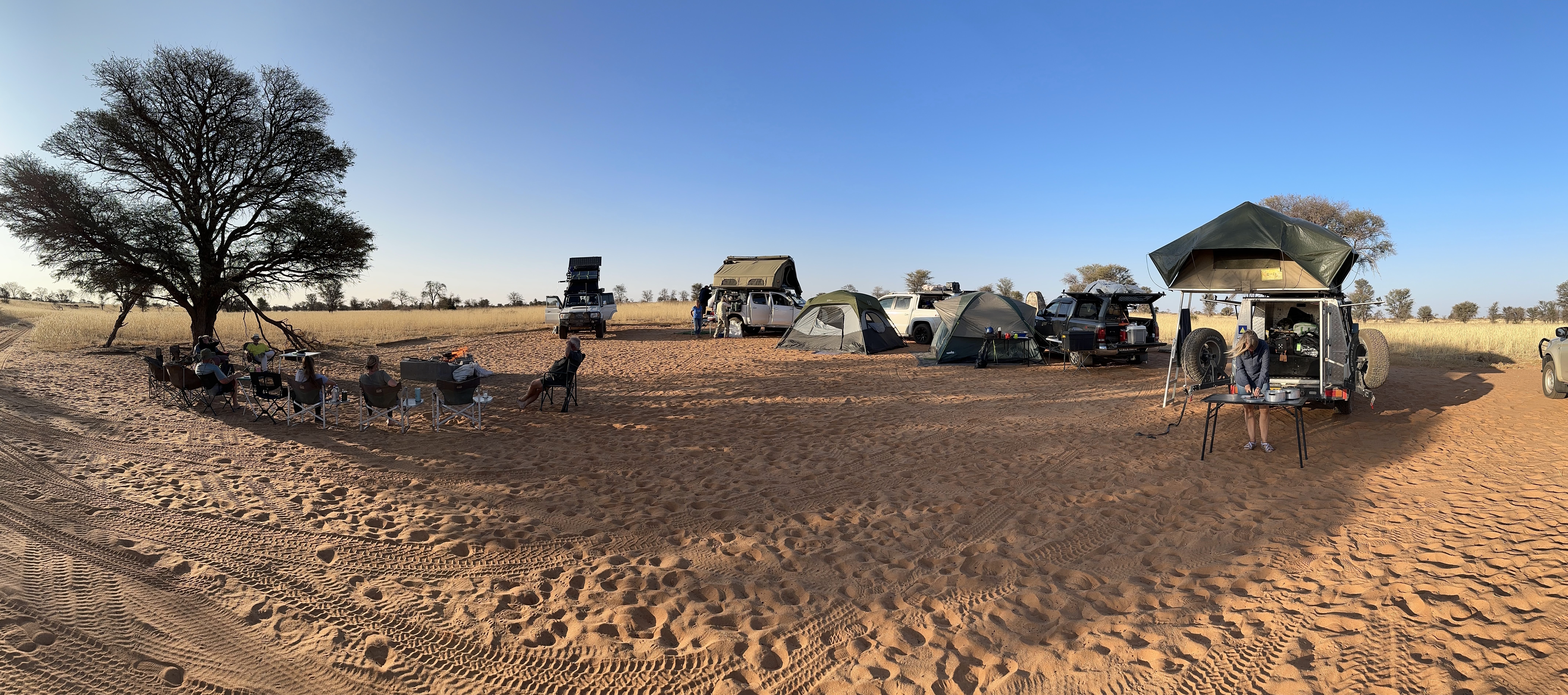
When we reach Camp 3, we spot lion tracks! Lions had visited the day before. We set up our tents/vehicles in a horseshoe-shaped ring, all with a view of a waterhole.


Lion track Witgab Camp at arrival.
Nossob 4x4 Eco Trail,
South Africa, 2024


Once again, there’s a long drop toilet and bucket shower, but this time the bucket shower is hidden behind a dune, so the camp isn’t visible – a bit eerie when you want a bath, in case a big cat sneaks up and no one can see it. On the other hand, the view from the shower is incredible, and just like the other showers, it’s completely open on one side.

In the evening, there’s a bit of a melancholy feeling around the campfire, as it's the last night on the Nossob 4x4 Eco Trail. Thys makes the most delicious bread rolls over the fire, which we enjoy with a view of the most beautiful full blood moon over the camp and desert.


Campfire Witgab Camp, 
Nossob 4x4 Eco Trail, 
South Africa, 2024.


Just before bedtime, we hear lions and quickly rush to pack up for the night until Thys later informs us (!) that it was just an ostrich. Sounds can be deceiving.

The trail ends about 40 kilometers north of Twee Rivieren Rest Camp. Before that, we enjoy yet another beautiful drive, with a lunch break on the edge of a dune under a giant shepherd tree, whose roots impressively reach 65 meters into the ground!


Blog author and wife under giant shepherd tree,
Nossob 4x4 Eco Trail, South Africa, 2024.


The Nossob 4x4 Eco Trail fully lived up to our expectations, not least due to the pleasant and knowledgeable ranger, Thys Burger. We will never forget him and this trip and will look back on it with great joy. We hope to return again – this time with a larger family or group of friends! Highly recommended!

Saturday, 14 September 2024

Nossob 4×4 Eco Trail, a 214 km adventure in the desert!


The day after Tomorrow, we start on the Nossob 4x4 Eco Trail that winds its way between two of the most frequented rest camps within the Kgalagadi Transfrontier Park – Twee Rivieren and Nossob. We will leave the traditional riverbed route connecting the two camps, and drive through the undulating dunes of the South African sector of the park. We expect a an unforgettable adventure with a blend of new 4x4 experience and excitement in combination with wildlife encounters.


The trail that winds its way
 between the undulating dunes for 214 km


The trail requires four days (three nights) of challanging 4x4 driving on a small trach through the Kalahari dunes, accompanied by a certified guide from SANParks. We will cover a total distance of 214km, with daily travel spanning approximately 50km to 60km.


Tracks4Africa App map.
You can see the three campsites


The wilderness campsites

We are going to spend the night at three distinct campsites, the three green tents on the map above, from the top:

  • Swartbas
  • Rosyntjiebos
  • Witgat

These campsites are rugged and compleetely unfenced, blending seamlessly into the wilderness of the Kgalagadi. They only provide very basic amenities such as long-drop toilets and bucket showers, akin to other wilderness camps in the park. Throughout the trail, we will be responsible for our own meals and drinking water and must bring ample supplies of food and water to survvive the four-day journey in the dunes.

Also, we have to bring our own firewood and braai equipment (grids etc.)


Sunset yesterday, Mata Mata Restcamp,
South Africa, 2024.


Optimal timing for trail travel?

September is an ideal time to embark on the trail, as it falls within the spring/early summer period. Generally, consider going during March/April/May or September/October/November.

If you consider to go, please note, it's essential to have a 4x4 vehicle with low range capability; otherwise, you will not be permitted to undertake the trail. However, a differential lock is not required. Adjust your tire pressure to 1.5 bar or below and ensure you carry sufficient fuel for at least 300km, considering the heavier fuel consumption typical of 4x4 trails. Both Nossob and Twee Rivieren have filling stations. Additionally, it is highly recommended to protect your vehicle against grass and grass seeds. There have been instances of grass seeds infiltrating radiators, leading to vehicle fires in the Kgalagadi.


Blogauthor, adjusting the tyre pressure
Namibia, 2024.


You can find a lot of practical information about the Nossob 4x4 Eco Trail on this homepage Link And the formal Sanparks page Link

We will post a full day by day experience report, when we are done with the trail and have internet again. 

Friday, 13 September 2024

Kgalagadi Transfrontier Park - a natureserve the size of Denmark!

Kgalagadi, a hidden gem in Kalahari Desert 


Son relaxing at Gharagab Wilderness Camp,
Kgalagadi Transfrontier Park, 2015.

Everything is just bigger in Africa. Today, we are at the Mata Mata border post about to venture into Kgalagadi Transfrontier Park, a vast wildlife preserve and conservation area in southern Africa nearly the size of Denmark at 38,000 square kilometers! We are in the border area between Namibia, Botswana, and South Africa. The park is largely situated within the southern Kalahari Desert, characterized by impressive and beautiful red dunes, sparse vegetation, occasional trees, and the hallmarks — the dry riverbeds of the Nossob and Auob Rivers. These rivers are said to flow only about once per century. However, water flows underground, providing life for grass and trees growing in riverbeds. Additionally, the rivers may flow briefly after large thunderstorms.


Sparse vegetation, occasional trees,
Kgalagadi Transfrontier Park, 2015.


In 2015, my son and I took a father-son trip to the area (link post). I fell completely in love with the area and promised myself that I would return with my wife in the future. And now we are here, very excited to visit the park and try the Nossob Eco 4x4 trail, popular among 4x4 enthusiasts (see later posts).

Wildlife and predetors


Ostriches, Kgalagadi, 2015.

We also look forward to enjoying the nature and wildlife. According to Wiki, Kgalagadi has abundant wildlife with over 470 documented species, including large predators such as lions, cheetahs, leopards, spotted hyenas, and brown hyenas. But also smaller mammals including African wildcats, bat-eared foxes, Cape foxes, black-backed jackals, caracals, genets, honey badgers, as well as meerkats and mongooses.


Brown hyenas, Kgalagadi, 2015. 

Cape fox, Kgalagadi, 2015


My son and I saw many interesting species last time we visited and had the "pleasure" of lions outside the tent (link blog).


Lions, Kgalagadi, 2015


You can also see large ungulates [hovdyr], such as blue wildebeests, gemsboks, springboks, steenboks, southern giraffes, common elands, greater kudus, warthogs, klipspringers, and red hartebeests.


It is also a bird lover's paradise, Kgalagadi, 2015.

And over 30 reptile and amphibian species, including venomous snakes such as the Cape cobra, horned adder, puff adder, and black mamba. So watch where you walk and what you touch! You also find, for example, leopard tortoises, various agamas, geckos, sand frogs, and African bullfrogs.

Since 2005, the protected area has been considered a Lion Conservation Unit and a lion stronghold in Southern Africa. Fortunately, we are in a rooftop tent, but even that is not a 100% guarantee, as you can read in this "scary" post (link blog).

The Weather

We are visiting in September and expect a mean temperature of 18°C (64°F) with lows/highs of 8-29°C. However, extremes measured are between -5 and 38°C, respectively! See climate data for Kgalagadi at this link (link). And come prepared with plenty of water and the right equipment. Also, because help might be hours to days away given it's a wilderness the size of Denmark

Facilities


Kalahari Tented Camp, Kgalagadi, 2015.


First of all, book well in advance! There are very few places to stay in the park, and they sell out one year in advance the moment they are released. Join the Kgalagadi Facebook groups to learn the tricks of securing accommodation. You can stay in the three tourist lodges called "rest camps," which are serviced lodges with amenities such as air conditioning, shops, and swimming pools. Alternatively, and much better in my opinion, opt for the reasonably priced wilderness camps in the park. The wilderness camps provide excellent shelter; for example, see our experiences and pictures from Gharagab (link blog) and Grootkolk (link blog). You have to supply your own food, drinking water, and firewood! (Basically everything). Read more about the park and booking at Sanparks link

Source: Kgalagadi_map.pdf (sanparks.org)