Showing posts with label Himba. Show all posts

Saturday, 26 October 2024

Etaambura Camp in Kaokoland


Etaambura Camp, main building with viewing platforms,
Namibia, 2024.

Our private platform and view,
Etaambura Camp, 2024.


A blend between Tranquility Base and the Garden of Eden!

We’re staying atop a mountain in one of the most remote places in the world: Etaambura Camp. Namibia’s first Himba co-owned camp situated in Orupembe Conservancy  It feels like a blend between Tranquility Base and the Garden of Eden (not that I’ve tried either one)!


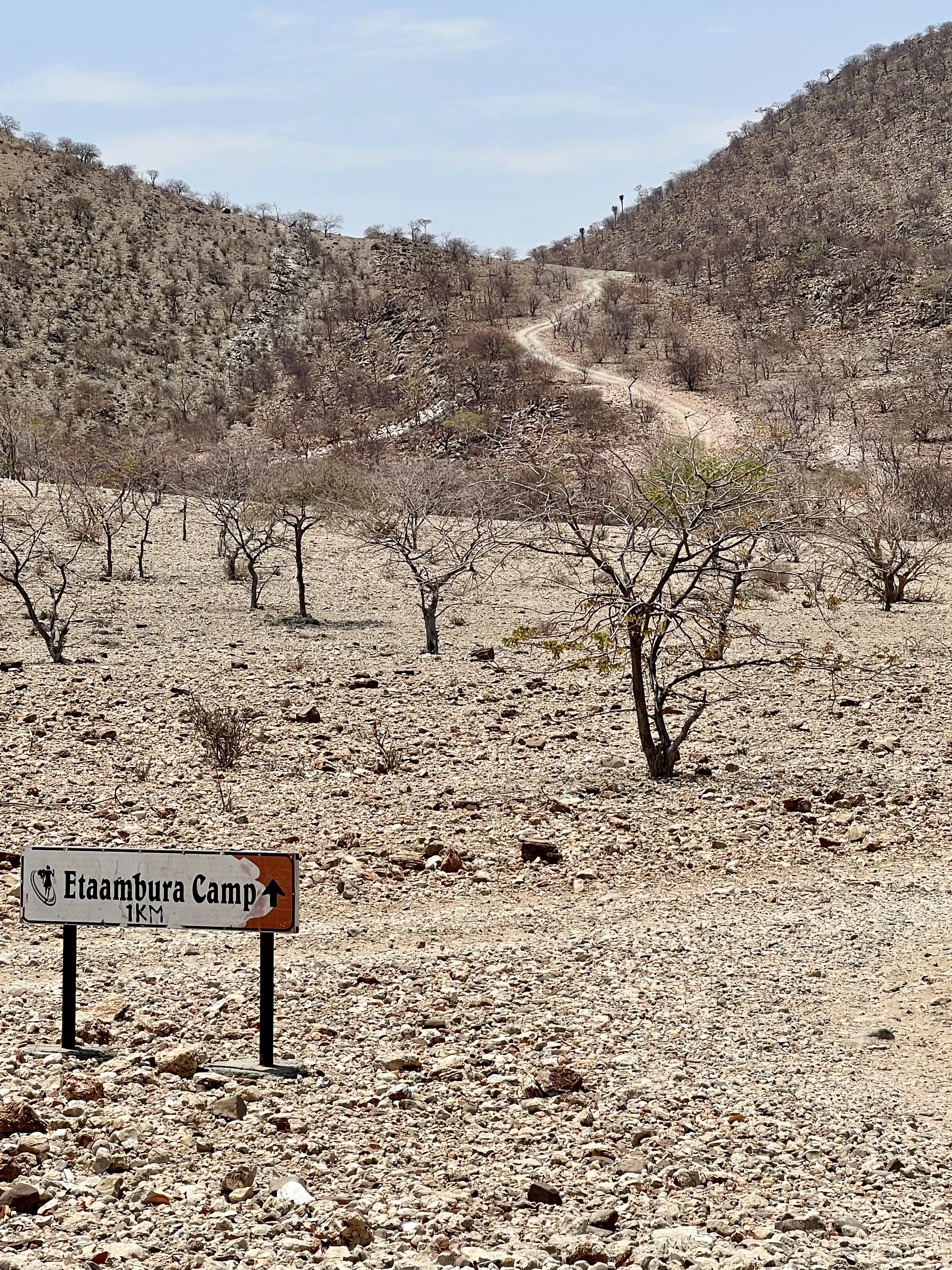
View from access road,
Etaambura Camp, Namibia 2024.

After six visits, this might be the place in Namibia that has left the greatest impression on us. We first visited Etambura Camp in 2012, and now, in 2024, this spot still exceeds our well-honed and adventurous imaginations. 


Etaambura camp, start access road,
Namibia, 2024.

Final 1,000 m to Etaambura Camp,
4WD vehicle and steady nerves!
Namibia, 2024

Etaambura Camp sits almost entirely inaccessible in the far reaches of Kaokoland in northwest Namibia, perched on one of the highest mountains in the area. The final 1,000 meters up the mountain on a small gravel path require a good 4WD vehicle and steady nerves, with steep slopes to your right most of the way. 


View North, Etaambura Camp, Namibia 2024.

Once you reach the top, the reward is a breathtaking 360-degree view of the sacred Onjuva plains, where the Himba people live peacefully among the wild animals. The Himba tradition forbids hunting in this area, as the plains are believed to be protected by ancestral spirits. Instead, they live off their livestock, cattle, and goats.

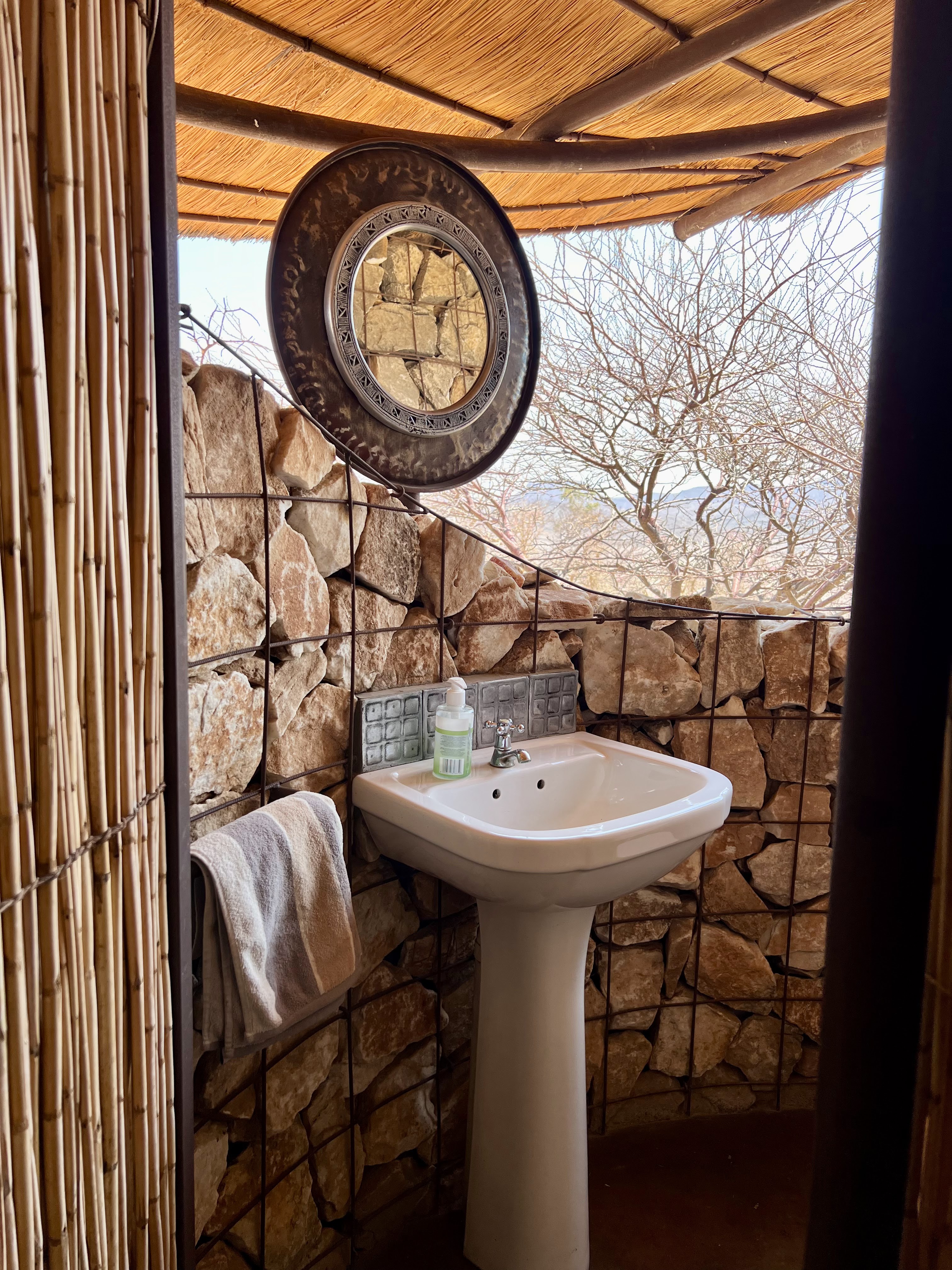
Etaambura’s main building sits at the very peak, crafted from local stones placed in gabions (raw metal netting) that support a thatched roof. Wood and smooth concrete floors complete the design, seamlessly blending Etambura into the mountain, enhancing its beauty. 

The furniture is solid wood and leather, and electricity is generated by solar panels, stored in batteries for evening and nighttime use. Water is sourced from a nearby borehole and driven up the steep path to the top of the mountain.


Our canvas tent with private viewing platform,
Etaambura Camp, Namibia, 2024

Our bed, last cabin,
Etaambura Camp, Namibia 2024.

Main building bathroom (one of two),
Etaambura Camp, Namibia, 2024.

Around the main building you find five spectacularly positioned canvas tents, each with its own gabion support, private viewing platform, toilet, and shower. Simple yet beautiful, these tents offer guests total privacy with unbelievable views of sunrises and sunsets over mountains and plains.'


The cooking is done over an open fire,
Etaambura Camp, Namibia, 2024.

Beef on fire!
Etaambura Camp, Namibia, 2024.

Accommodating up to 10 guests, the camp provides about 250 square meters of space along with two friendly local helpers who handle practical tasks like lighting the fire, heating water, setting tables, and washing up. Guests must bring their own food, though some beverages are available on-site. The nearest supermarket is eight hours away in Opuwo! Guests can get cooking assistance from the local helpers or choose to cook for themselves.


Platforms offer the most jaw-dropping views!
Etaambura, Namibia, 2024.

Platforms offer the most jaw-dropping views!
Sunset, Etaambura Camp, Namibia, 2024. 

Around the main building, terraces and platforms offer the most jaw-dropping views! There’s no doubt this place ranks in our top three of the most beautiful locations we’ve stayed in (in 22 African countries). 


Etaambura Camp view,
Tranquility Base + Garden of Eden
Namibia, 2024.

Indeed, this is blend between Tranquility Base and the Garden of Eden. But it’s not necessarily for everyone. This isn’t a luxury lodge with 24/7 service and every amenity – it’s luxury and peace on a far more sublime level.

Link to Etaambura Camp Homepage (link)


Thursday, 3 October 2024

Into Kaokoland, Africa´s last wilderness


Right now, we are at Khowarib Lodge Campsite. Tomorrow, the adventure continues in the most remote region in Namibia, when we head for Kaokoland. Below, you can read about this special area and part of the trip, we look very much forward to!


Kaokoland Namibia 2012
On the way from Sesfontain to Puros on D3707

"Kaokoland" (since 1990, Kunene Region) remains an informal name for one of the wildest and least populated areas in north-west Namibia, with a population density of one person every 2 km². The Kaokoland area extends south-north from the Hoanib River to the Kunene River, which also marks the border between Namibia and Angola. It is largely mountainous, dry, and rocky as seen on pictures above and below.

Family in Kaokoland 2012. Near "Puros view point". 
We didn't dare drive the Land Rover the last stretch up the mountain!

Desert Elephants


Desert elephant in Puros Canyon.
It chased our Land Rover!
Namibia 2012.

Kaokoland includes several desert-dwelling species, most notably a population of desert elephants that are sometimes classified as a distinct subspecies of African elephants due to their unique adaptations. These elephants have longer legs, bigger feet, and an incredible ability to withstand periods of drought, which led some to consider them a separate subspecies. However, today they are regarded as 'desert-adapted' elephants. The herds in this area remain separate from other elephant herds in Namibia and only appear to have longer legs and bigger feet because they consume less food than elephants in more abundant areas such as Etosha National Park, the Caprivi, and the Chobe region in Botswana.

The desert elephants inhabit a range of three thousand square kilometers and regularly travel up to two hundred kilometers in search of water. They drink only every three or four days, compared to elephants in Etosha who drink 100 to 200 liters of water a day. They also seem to be more environmentally conscious than other elephants: unlike other elephants, the desert-adapted elephants rarely knock over trees, break branches, or tear away bark.

They commonly roam the dry riverbeds of the westward-flowing Huab, Hoanib, Hoarusib, and Khumib rivers. It is along these riverbeds that the animals find occasional spring-fed waterholes and most of their nutrient-rich foods: mopane bark, tamarisk, reeds, and the pods, bark, and leaves of the ana tree. 
On a typical day, desert elephants travel up to sixty kilometers over rocky, difficult terrain between feeding areas and waterholes. When water is truly scarce, such as during times of drought, they dig holes, commonly known as gorras, in the dry riverbeds. Water seeps up from below the surface, creating a much-needed water source for themselves and other animals in the area.


Our son in Hoarusib riverbed after our elephant encounter.
Kaokoland, Namibia 2012

Puros conservancy (source)

The Himba

The Puros Conservancy covers a vast area of over 3,500 square kilometers but is home to only a small population of around 300 people, most of whom speak Otjihimba. The Himba, part of the larger Herero language group, first settled in what is now the Kunene Region about five hundred years ago, arriving from the north. While the main Herero community moved on to central Namibia in the 1750s, some groups remained in northern Kunene and eventually became known as the Himba. In this remote and mostly arid area, the Himba have retained a strong cultural identity that is still evident today. Due to its harsh environment, the Puros area has always been marginal for settlement but has supported small groups of semi-nomadic Himba pastoralists for generations. Permanent settlement in Puros only began to develop around forty years ago.


Visit Puros Traditional Village, Namibia 2012

Visit Puros Traditional Village, Namibia 2012 

Visit Puros Traditional Village, Namibia 2012

Visit Puros Traditional Village, Namibia 2012

The traditional culture of the Himba is iconic. Proud pastoralists herd their cattle across the spectacular landscapes of the northwest, while women in traditional dress, anointed with a mixture of butterfat and red ochre, tend to village tasks. Although the settlement of Puros has gradually lost many traditional Himba attributes, the nearby Puros Traditional Village offers visitors insights into the cultural heritage of the Himba. It showcases practical aspects of daily life and explains important elements such as the holy fire and the system of dual descent that governs Himba society. The traditional village also keeps alive a sense of pride in the community's cultural heritage.


Puros Traditional Village, seen from view point
Namibia, 2012


Wildlife

Since the establishment of conservancies, wildlife numbers in communal areas have rebounded from historic lows prior to independence. The elephants and lions of Puros are emblematic [symbolsk], providing countless visitors with thrilling encounters. Giraffes are common, and black rhinos roam the remote hinterland. Kudu, gemsbok, springbok, Hartmann’s mountain zebra, duiker, steenbok, and klipspringer all occur here, stalked by an assortment of predators, including leopard and cheetah, spotted and brown hyena, and jackal. Puros is completely unfenced, allowing wildlife to move freely across the conservancy and beyond its borders.


Lonely Gemsbok seen in the stone desert
between Puros and Orupempe
Kaokoland, Namibia, 2012

Ostrich seen between Sesfontain and Puros.
Kaokoland, Namibia, 2012

Our son was an expert at spotting owls!
On steep access road to Etambura Camp
Kaokoland, Namibia, 2012


Free-Roaming Lions

Free-roaming lions in the Kunene Region have recovered from a population low of only 25 individuals in the mid-nineties to well over a hundred today. The lions range as far south as the Ugab River, north to the Marienfluss, and west to the misty beaches of the Skeleton Coast. Conflicts with the lions pose a huge challenge for local farmers, and many lions continue to be shot and poisoned. While other predators such as spotted hyena, leopard, and cheetah cause more incidents each year, lions feature most prominently in the consciousness of people, as they also present a direct threat to human life.


We haven't had the pleasure of seeing lions in Kaokoland (yet),
but this one my wife and I saw south of Etosha, Namibia 2022


Monday, 12 August 2019

Epupa Falls, a green oasis in Kaokoland

Kaokoland and Epupa Falls, the extreme northwest Namibia


The Epupa waterfalls are series of falls extend over a wide area.
There are giant baobab trees and palm trees everywhere,
surrounded by the dry Kaokoland and Zebra mountains, Namibia 2019

From Opuwo to Epupa Falls 180 kms along C43 

We leave Opuwo, the "Wild West" town in the northwest

We leave Opuwo, not a place we will miss. We are on our way to Epupa Falls. Opuwo seems to be very affected by the drought in Namibia. It is a small and uninspiring town in the middle of the bush, but you can find fuel, supplies and banks. It feels like "Wild West". At the gas station in the middle of the city, street children and poor people come begging. The kids "wash your car" whether you want it or not and ask for payment. You have to look very carefully for your belongings, but they do not seem threatening. The gas station staff seems to have giving up. We hope the coming rainy season will be a good one. There is a desperate need of water in the area, especially for goats and cattle that are important in this area.

We stayed at Opuwo Country Lodge, which also seemed affected by the harsh conditions. Dust everywhere. The road up to the lodge hilltop looked like something that was a lie. It was in a very bad condition surrounded by dead trees and shrubs. Strange afterwards to relax on the edge of the infinity pool afterwards in this troubled city.

Gas station in the middle of Opuwo
Street kids and poor people come begging
Namibia 2019

Opuwo, Namibia 2019

North towards Epupa Falls

We drive from Opuwo via C43. We head for Okongwati. As there are no likely supplies of diesel before Ruacana several days ahead, we have refueled the car completely with 80 liters of diesel. Also, we bring plenty of liquid.

We drive cautiously, it´s very far between inhabited areas and you pay on the spot for any errors. We are reminded by the rusty car wrecks on both sides off the road. A moment of inattention, and you might be heading over the side of the dirt road or slip out in a sandy curve. Then, you might easily hit the banks of a (dry) stream under the road or drive down a slope overturning the car. If so, you have to wait for hours for the next car to pass (given you are alive).

One of the few "towns" we pass 

The landscape changes 

As you head north, the landscape changes. You see scattered Himba towns in the characteristic red colors and round enclosures for the animals. From Okongwati to Epupa Falls, there are 73 kilometers. You drive through the Zebra Mountains, which rises on the right. Now, there are more trees, even some giant baobabs.

We are approaching Kunene River. We had heard that we should not expect to much of the Epupa Falls, which are located in the northernmost part of Namibia on the border to Angola.

This is completely wrong. Suddenly, as we drive around the last hilltop, we see a very green wide line of palm trees in the landscape.

Suddenly, we see a very green line of palm trees in the landscape
Kunene River, Namibia 2019 

It seems very dramatic after the long trip through the dry countryside and mountains. This must be as reaching an oasis in the desert after days of hiking? The life-giving water. The Kunene River flows to the South Atlantic Sea from Ruacana Falls Hydroelectric Power Station and for 300 kms. and forms the (now) peaceful border with Angola.

Father, son and daughter at Epupa Falls viewpoint
Namibia 2019

The waterfalls

The waterfalls themselves are a series of falls, the highest 32 meters, which extend over a very large approx. 500 meters wide area. There are giant baobab trees and palm trees everywhere, surrounded by the dry Kaokoland and Zebra mountains.

Epupa Falls, Namibia 2019

It is a good experience to walk around the area by the falls. We ended the trip by driving up to the Epupa Falls viewpoint and enjoying the sunset view. A this spot, you get a fantastic overview of the whole area. People are very welcoming and it seems safe.

Me taking photos at Epupa Falls Viewpoint
Namibia 2019

We live at the nice Epupa Camp approx. 700 meters above the waterfalls. This place is clearly recommended.

The cottage, Epupa Camp, Namibia 2019

The cottage, Epupa Camp, Namibia 2019

The swimmingpool next to Kunene River,
Epupa Camp, Namibia 2019

View from Epupa Camp, Namibia 2019

Enterence, Epupa Camp, Namibia 2019